EuroLeague Handicap Betting: Mastering Point Spreads for UK Bettors
 Available in US
Panathinaikos was a 12-point favourite at home against Maccabi Tel Aviv. They won by 11. If you’d backed the moneyline, you collected. If you’d taken Panathinaikos minus 12, you lost. That single point — the difference between covering the spread and missing it — encapsulates why handicap betting demands different thinking than simply picking winners.
Point spread betting eliminates the certainty that makes heavy favourite matchups unappealing. When Real Madrid hosts a relegation-threatened opponent, the moneyline might sit at 1.10 — risking £100 to win £10. The spread transforms that same game into an even-money proposition: will Madrid win by more or fewer than 15 points? Suddenly the bet has teeth.
EuroLeague averages around 161.2 points per game across recent seasons, with individual matches spanning from defensive slugfests in the 130s to offensive explosions past 180. This scoring variance creates opportunities for spread bettors who understand how pace, efficiency, and matchup factors translate into margin of victory. Throughout this guide, I’ll break down exactly how to read, interpret, and exploit EuroLeague point spreads from a UK betting perspective.
Table of Contents
How Handicap Betting Works in EuroLeague
The concept is straightforward once you see it in action. Bookmakers assign a point deficit to the favourite and a corresponding advantage to the underdog. Fenerbahçe minus 7.5 means they must win by 8 or more for a bet on them to pay out. Zalgiris plus 7.5 means they can lose by up to 7 points and still “cover” for their backers.
That half-point matters. In American sports betting, you’ll encounter full-number spreads like -7 where the result can land exactly on the number, creating a “push” that returns your stake. European bookmakers typically use half-points specifically to eliminate pushes — every bet resolves as a winner or loser. Some UK operators offer both formats, so checking the specific line structure before betting prevents confusion.
Spread odds usually hover near even money — typically 1.90 to 1.95 on each side. This tight pricing reflects the bookmaker’s belief that the spread accurately captures the expected margin of victory. When you see one side priced at 1.85 and the other at 2.00, the book is signalling where they expect more action rather than where they see the “correct” line. These pricing imbalances sometimes indicate value.
The spread itself moves based on betting action and information changes. A line opening at -6.5 might close at -8.5 if heavy money lands on the favourite. Tracking these movements reveals where professional bettors are positioned and whether the closing line offers more or less value than the opener.
Asian Handicap vs European Handicap Explained
The terminology can confuse bettors coming from football. Asian handicaps in football eliminate draws through quarter-point splits and stake division. In basketball, where draws essentially don’t exist, the distinction matters less — but UK bookmakers still label their products differently, so understanding the terminology helps you navigate betting sites.
European handicap in basketball typically presents three-way markets: Team A covers, Team B covers, or the margin lands exactly on the spread number. This three-way structure allows whole-number spreads while still offering action on the push outcome. The odds on the exact number are usually quite long — 15.00 or higher — reflecting how rarely basketball margins hit specific integers.
Asian handicap eliminates that push possibility entirely through half-points or by voiding bets that land exactly on the number. Most EuroLeague spread betting at UK bookmakers follows the Asian model with half-point lines. You’ll see -5.5 rather than -5, and every bet resolves definitively.
Some operators offer both formats on the same match. The European three-way handicap might show Milan -6 at 1.90, with the push option at 20.00 and Alba Berlin +6 at 1.90. The Asian version shows Milan -6.5 at 1.91 and Alba +6.5 at 1.91. Mathematically, these are different bets with different expected values. Choose based on your assessment of where the margin is most likely to fall.
Reading and Interpreting Spread Numbers
A spread of -8.5 tells you the market expects approximately an 8-point victory margin. But that single number compresses enormous uncertainty. The favourite might win by 20. They might lose outright. The spread represents the median expectation, not a prediction of what will actually happen.
Key numbers in basketball differ from football. While football bettors obsess over 3 and 7 — common scoring increments — basketball margins distribute more evenly across a wider range. No single-digit number holds special significance the way a field goal or touchdown does. This means moving through basketball spreads carries relatively consistent value per point, unlike football where buying off key numbers offers premium edge.
Context shapes how to interpret any given spread. An 8-point line between evenly matched teams playing at a neutral venue suggests different dynamics than the same spread for a dominant home side against a struggling visitor. The number alone doesn’t tell you whether the spread is accurate — only your analysis of the underlying matchup reveals that.
I look for disconnects between spread size and public perception. When a traditionally powerful club like CSKA Moscow carries only a 3-point spread at home, the market is telling you something about their current form that casual bettors might miss. Conversely, when an unfamiliar team like Virtus Bologna gets a double-digit spread against them despite competitive recent performances, the line might overweight reputation over reality.
Why Handicap Betting Suits EuroLeague Matchups
EuroLeague’s competitive structure actually creates better spread betting opportunities than most casual observers realise. The league operates on a closed licensing model — teams hold long-term spots regardless of domestic league performance — which produces more predictable rosters and styles from season to season than promotion/relegation leagues offer.
Average attendance reached a record 10,589 fans per game during the 2024-25 regular season, marking the fourth consecutive season with new attendance records. This growing audience creates genuine home court atmospheres that factor into spread calculations. Some venues intimidate visitors more than others, and these environmental effects persist across seasons in ways that reward bettors who track them.
The 2025-26 expansion to 20 teams increased the talent dispersion slightly. With 38 games per team instead of 34, scheduling also became more demanding. These structural changes affect spread dynamics: more tired teams on more nights means more variance in margin of victory from matchup to matchup.
Home Court Advantage Data in Spread Context
Partizan Belgrade led all EuroLeague clubs in attendance during 2024-25, averaging 18,486 fans at 98% arena capacity. Crvena Zvezda followed closely with 18,239 fans at 94% capacity. These aren’t just impressive numbers for European basketball — they’re environments that genuinely affect game outcomes and, by extension, spread coverage.
Home court advantage in EuroLeague translates to approximately 3-4 points in expected margin versus a neutral venue, though this varies substantially by team. Clubs with passionate local fanbases in smaller arenas sometimes create more intimidating environments than larger venues with corporate atmospheres. Bayern Munich’s move to SAP Garden Arena drove a 75% attendance increase in 2024-25, and tracking whether that translated to improved home margins helps calibrate current spreads.
Bookmakers price home advantage into spreads, but not always accurately. Early in the season, they rely on historical data that may not reflect current roster changes or venue situations. A team that lost its primary scorer to injury will see their spread adjustment, but the corresponding reduction in home court edge might lag. These gaps between priced advantage and actual advantage create spread betting opportunities.
Road teams playing their third game in eight days face compounding disadvantages that spreads may underestimate. The nominal home edge of 3-4 points gets amplified when visitors arrive exhausted. I weight travel and rest factors more heavily than pure historical home/away splits when assessing spread value.
Competitive Balance Across the 20-Team Field
EuroLeague’s talent distribution is simultaneously more concentrated and more unpredictable than NBA betting regulars expect. The top 5-6 clubs typically control the largest payrolls — research revealed minimum budgets of $7 million per club for 2025-26, with top spenders several multiples higher — but upsets happen more frequently because the single-game sample size and international playing conditions introduce variance.
This balance creates spread opportunities in both directions. Heavy favourites sometimes crush opponents by margins exceeding their spread, but they also sleepwalk through matches against inferior competition and fail to cover. Underdogs stay competitive more often than their spreads suggest, but they also collapse in blowouts. The key is identifying which matchup profile applies to a specific game.
Dubai Basketball’s entry as the first non-European club adds another dimension to competitive balance analysis. Their travel schedule — flying to Europe for every road game — creates systematic disadvantages that might exceed what spreads account for. Conversely, European teams visiting Dubai face unfamiliar conditions that could narrow expected margins.
I track each team’s spread performance against the closing line, categorised by opponent tier. Some clubs consistently cover against top competition but underperform against weaker opponents. Others show the opposite pattern. These tendencies persist across seasons and inform spread selection even when the headline numbers look unremarkable.
Spread Betting Strategies for EuroLeague
My approach to EuroLeague spreads centres on identifying situations where the market has priced in obvious factors but missed less visible ones. Everyone knows Real Madrid is favoured at home. Fewer bettors check whether their opponent just played two days ago in another country. The obvious gets priced efficiently; the subtle often doesn’t.
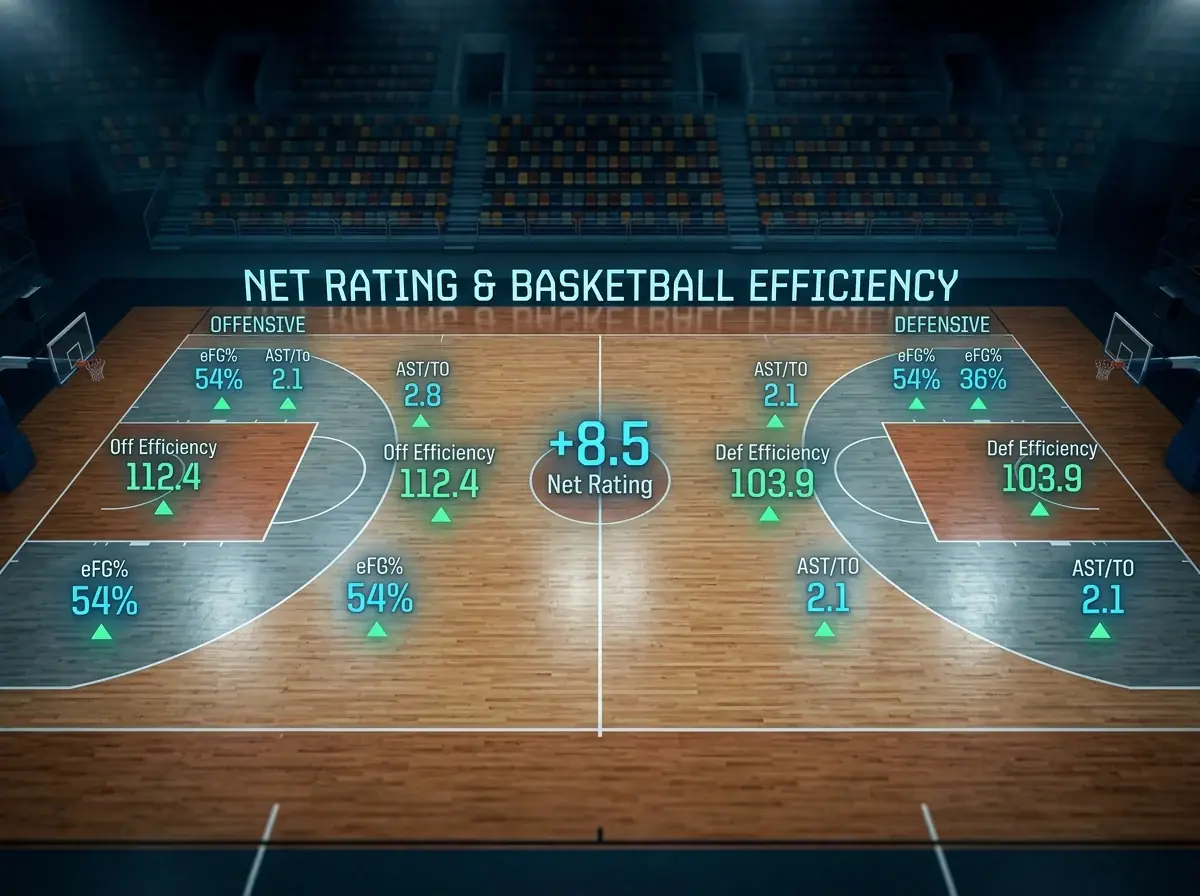
Efficiency metrics offer another edge. Early 2025-26 data showed Fenerbahçe posting a Net Rating of +21.3 with an elite Defensive Rating of 95.4. Meanwhile, Hapoel Tel Aviv led all teams with an Offensive Rating of 138.1 despite being priced as mid-table competition. Teams outperforming their reputation create spread value until the market catches up — usually 2-3 weeks of sustained performance.
Pace differentials matter for spread betting specifically. When a fast team plays a slow team, the total adjusts downward, but the spread implications are subtler. The fast team prefers more possessions; the slow team wants fewer. Whichever team gets its preferred game tends to cover more often. Identifying which team controls tempo — usually through rebounding and turnover rates — helps predict margin direction.
Motivation gaps create spread edges too. A team locked into playoff position playing against a club fighting for their tournament life faces an intensity mismatch that spreads rarely capture fully. Late-season EuroLeague matchups between clinched teams and desperate ones offer some of the most exploitable spreads of the year.
Fading Road Teams After Long Travel
Teams arriving from distant away games face compounded challenges that spreads underestimate. As the BettingExpert editorial team noted in their 2025-26 season preview, clubs returning from long-haul flights or playing back-to-back can be particularly vulnerable. A team flying from Turkey to Spain might be undervalued by the market at precisely the moment their legs feel heaviest.
The physical toll is obvious. The less visible impact is preparation time. A team landing at midnight Sunday after a Thursday away game has fewer practice sessions before their Wednesday home fixture. Meanwhile, their opponent rested at home all week. That preparation asymmetry affects execution in ways that show up more reliably in margin than in win probability.
I track travel distances for every EuroLeague fixture. Istanbul to Moscow exceeds 1,700 kilometres. Tel Aviv to Kaunas tops 2,500 kilometres. These aren’t quick hops — they’re gruelling journeys with time zone shifts that disrupt sleep patterns. When one team carries this burden and their opponent doesn’t, I give serious consideration to backing the rested home side against the spread.
The market gradually incorporates travel factors as the season progresses, but early-season pricing often lags. September and October spreads treat all road games roughly equally. By January, bookmakers have more data on team-specific travel effects. This suggests the best travel-based spread edges appear in the season’s first third.
Back-to-Back Game Handicap Adjustments
EuroLeague teams also compete in domestic leagues, creating scheduling congestion that occasionally forces back-to-back situations. A club playing Sunday in their national championship faces compromised recovery before Thursday’s EuroLeague fixture. These schedule crunches affect deep teams differently than shallow rosters — another factor spreads may underweight.
Roster depth becomes crucial in condensed schedules. Teams with 10-man rotations can manage minutes across both competitions. Teams relying heavily on 6-7 players accumulate fatigue faster. Checking minutes distribution from recent games reveals which clubs are running their stars into the ground versus spreading the load.
The second game of a back-to-back consistently underperforms spread expectations. This isn’t just my observation — it’s a documented pattern across basketball leagues globally. A team favoured by 6 points on normal rest might be closer to a 3-point favourite on the second night of consecutive games. If the spread doesn’t adjust proportionally, value exists on their opponent.
Watch for domestic cup competitions that fall mid-week during EuroLeague weeks. A team advancing deep in their national cup plays additional high-intensity games that compound fatigue. Their opponent who exited early has fresher legs. These asymmetric rest situations create spread opportunities that persist until the market learns to price them correctly.
Spread Betting and Match Integrity Considerations
Match manipulation exists in basketball. Acknowledging this reality helps you bet more intelligently, not more paranoidly. Sportradar monitored over 1 million sporting events across 70 sports in 2025 and flagged 1,116 as suspicious — representing less than 0.5% of total events. The vast majority of matches you bet on are clean competitions.
Basketball ranked as the second most targeted sport globally in 2025 with 233 suspicious matches flagged — a 24% increase from the previous year. Europe showed the highest concentration of suspicious activity at 385 cases across all sports, though this number decreased for the second consecutive year. These statistics warrant awareness without justifying paranoia.
Andreas Krannich, Sportradar’s Executive Vice President for Integrity Services, summarised the situation clearly: the relative stabilisation of suspicious match numbers is encouraging but underscores the need for constant vigilance. Match-fixing remains an evolving threat requiring sustained investment in monitoring technology and cross-border cooperation.
For bettors, this means exercising appropriate caution with unusual line movements that lack obvious explanation. When a spread shifts dramatically without injury news or public information, something is happening that you can’t see. Whether that’s sharp money with superior analysis or something more concerning, the prudent response is the same: step aside rather than chasing mystery movements.
Why Spreads Are Targeted by Manipulation
Totals and spreads have been identified as the most targeted markets for basketball manipulation. The logic is straightforward from a fixer’s perspective: controlling the margin is easier than controlling the outcome. A team can lose by 12 instead of 8 without obviously throwing the game. Missing a few late free throws, taking a questionable three-pointer instead of a layup — these subtle adjustments affect spread coverage without raising immediate suspicion.
Point-shaving schemes in American collegiate basketball have historically focused on first-half totals specifically because they’re easier to manipulate in isolation. A player can underperform for twenty minutes then play normally, making detection harder than obvious game-throwing across forty minutes. European basketball faces similar risks, though professional leagues with better-paid players generally present fewer manipulation opportunities than lower-tier competitions.
EuroLeague’s high profile offers some protection. The league commands significant television audiences — 459 million viewers globally from October 2024 to early 2025 alone — and that visibility increases scrutiny on unusual results. Lower-tier European leagues without comparable monitoring face greater risks.
Betting patterns often reveal manipulation before results do. When significant money moves a spread in one direction without corresponding public information, monitoring services flag the activity for investigation. As a bettor, you benefit from this surveillance without directly participating in it. Sticking to well-monitored competitions like EuroLeague reduces your exposure to compromised events.
Alternative Spreads and Buy Points Options
Standard spreads aren’t your only option. Most UK bookmakers offer alternative lines — typically in 2-point increments from the main spread — at adjusted odds. If the primary line shows Olympiacos -6.5 at 1.91, you might find -4.5 at 1.72 or -8.5 at 2.15. These alternatives let you express more nuanced opinions about margin expectations.
The pricing on alternative spreads follows logical patterns. Moving the spread in your favour costs you odds; moving it against your position improves your price. The question becomes whether the odds adjustment compensates fairly for the probability change. This requires understanding how basketball margins distribute around expected values.
Basketball margins cluster somewhat normally around the true expectation, but with fat tails — blowouts happen more often than a pure bell curve would predict. This means buying points near the expected margin carries different value than buying points far from it. Moving from -6.5 to -4.5 when the “true” spread is -6 offers more value than the same 2-point move when you’re already 8 points away from the market line.
I use alternative spreads when my analysis suggests the market line sits at an inflection point in the margin distribution. If I expect a game to be either close or a blowout — with little probability of landing in the 6-10 point range — buying through that range to -4.5 or selling through it to -10.5 captures my view better than accepting -7.5 at standard juice. The key is having genuine conviction about margin distribution, not just hoping for more cushion.
Some bookmakers offer “buy points” features where you can adjust the spread incrementally for proportional odds changes. Compare the cost per point across operators — it varies more than you’d expect. Paying 1.80 for a 2-point move at one book versus 1.75 for the same adjustment elsewhere adds up across a season of spread betting.
Frequently Asked Questions
What is the typical point spread range in EuroLeague matches?
EuroLeague spreads typically range from pick’em games between evenly matched opponents to 15-point advantages for elite home favourites against struggling visitors. Most matches fall in the 3-10 point range. Spreads exceeding 12 points are relatively rare and usually involve significant talent or form mismatches.
How does home court advantage affect EuroLeague spreads specifically?
Home court advantage in EuroLeague translates to approximately 3-4 points in expected margin, though this varies by venue. Clubs like Partizan Belgrade and Crvena Zvezda with passionate fanbases and near-capacity attendance may warrant higher adjustments. Bookmakers build this advantage into spreads, but don’t always calibrate it accurately for specific matchups.
Are alternative spreads worth the reduced odds in EuroLeague?
Alternative spreads offer value when your analysis suggests the market line sits at an inflection point in probable margins. Buying points makes sense if you expect a close game or blowout but not a margin landing near the standard spread. The key is having genuine conviction about margin distribution rather than simply seeking extra cushion.
How do bookmakers set EuroLeague spreads differently from NBA spreads?
EuroLeague spreads incorporate different contextual factors including international travel fatigue, domestic league scheduling conflicts, and venue-specific home advantages. Margins also reflect tighter overall competitive balance — fewer blowouts mean spreads cluster in narrower ranges. UK bookmakers typically import continental European pricing then adjust for their specific liability and regulatory requirements.
Integrating Handicaps Into Your EuroLeague Betting
Spread betting rewards different skills than moneyline wagering. Picking winners requires identifying the better team. Picking covers requires identifying margin expectations more accurately than the market. Sometimes the better team fails to cover; sometimes the worse team loses but beats the spread. Embracing this distinction changes how you approach research and analysis.
Start by tracking your spread bets against closing lines. If you’re consistently betting sides that move against you by game time, your timing or information sources need improvement. If you’re catching favourable movements, you’re likely identifying value before the broader market recognises it. This feedback loop accelerates learning faster than simply tracking wins and losses.
The comprehensive guide to EuroLeague basketball betting covers the broader strategic framework that spread betting fits within. But the specific skill of handicapping margins — understanding how points get distributed across forty minutes of professional basketball — deserves dedicated attention. The bettors who master spread analysis often find it more consistently profitable than moneyline betting precisely because margins offer more exploitable inefficiencies than binary outcomes.
Written by the editors at Euroleague Basketball Betting.